Architecture#
End-to-end view of the pipeline: how human-recorded trajectories flow through replay, fusion, training, evaluation, and reporting.
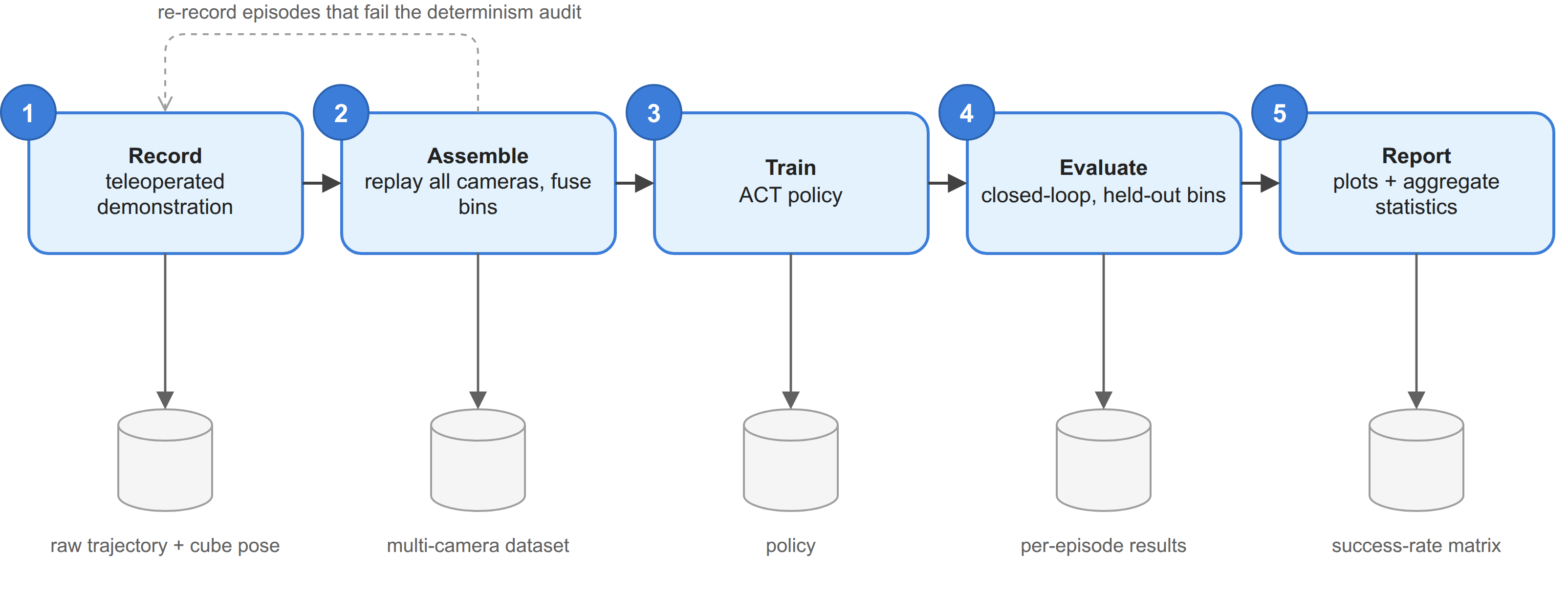
Every stage reads files and writes files, and nothing is passed in memory, so
each one is re-runnable in isolation. The chain is not a strict one-in-one-out
line: evaluation, for instance, takes the stage-3 checkpoint, a stage-1
recording bin for the cube placements, and a scene configuration. The dashed
loop is a practice rather than a mechanism: the determinism audits
(audit.determinism, audit.cube_replay) are run by hand, and episodes that
fail them are re-recorded before assembly. No script enforces that.
Where the human is#
Only in stage 1. The operator teleoperates the arm, and everything downstream is deterministic replay, training, and measurement. This is what makes camera configurations comparable: policies trained on different camera subsets share one set of human demonstrations.
What each stage produces#
Stage |
Command |
Artefact |
|---|---|---|
1 Record |
|
LeRobot dataset per bin, plus the per-episode scene state and the bin map |
2 Assemble |
|
one multi-camera dataset per bin, fused into the training corpus |
3 Train |
|
ACT checkpoints for one camera subset |
4 Evaluate |
|
per-episode results, summary, videos |
5 Report |
|
plots and written summaries, single-run and cross-run |
Frames and scene#
Every stage in the diagram above runs inside the same environment, and it is a deliberately plain one:
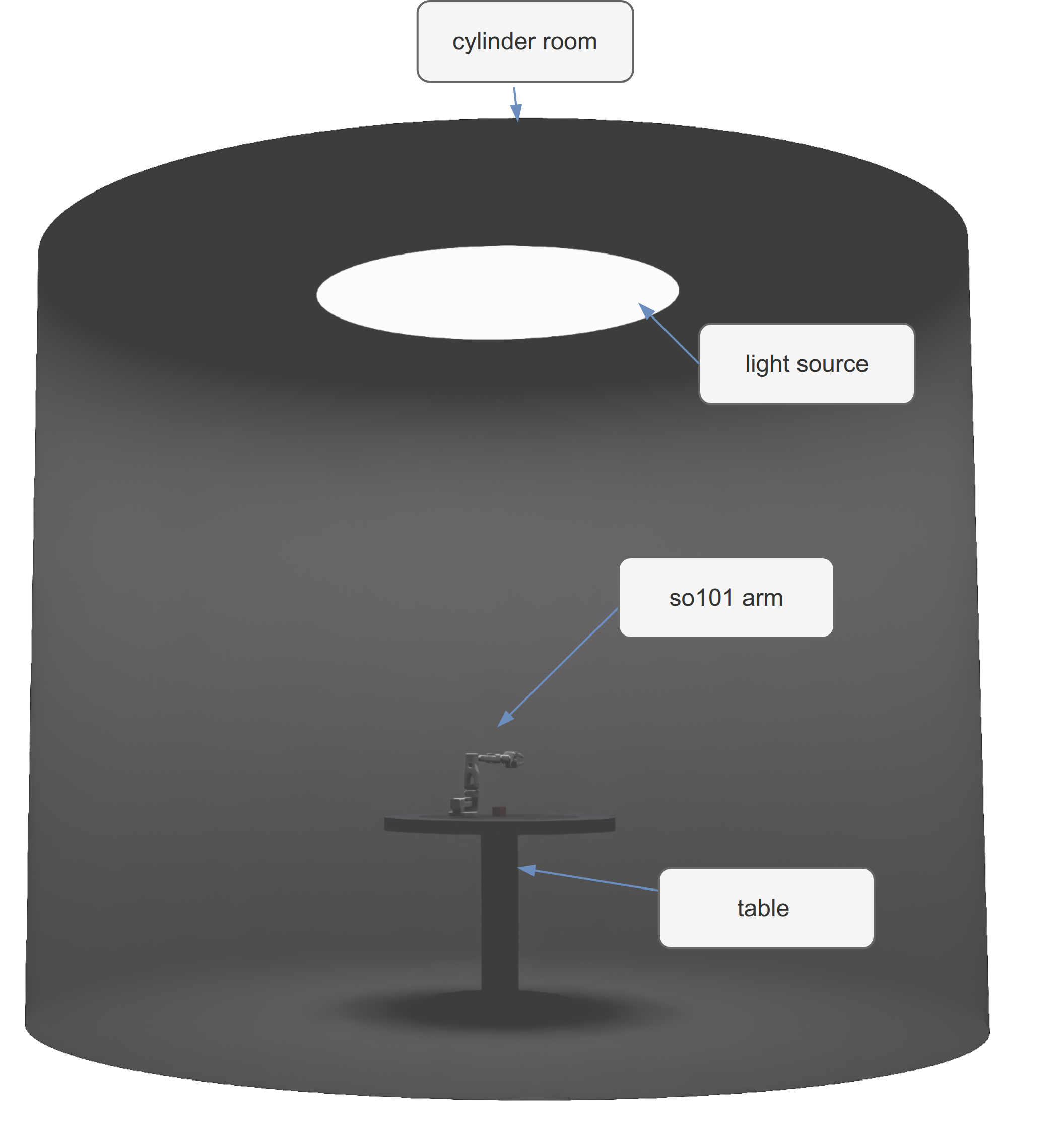
A closed cylinder, a round table, and the arm on it. The lighting is a disc in the ceiling for the visible pool of light plus a dome for the ambient fill. There is no window and no textured wall, so a camera moved to a new viewpoint sees the same room as the one it replaced, from a different angle. That is what makes a viewpoint comparison a comparison of viewpoints.
Plain is not the same as fixed. Both light exposures are randomisable, and that is one of the out-of-distribution axes rather than an accident of the scene (Evaluation variants). What the policy is asked to generalise over is chosen, and it lives in the scene configuration: where the cameras sit, and where the cube spawns.
Every scene is described by one value: the position of the workspace frame {W}. Cameras, cube, bin grid and arm base are anchored relative to it, which is what lets a recording made in one scene replay in another. The contract is on Coordinate frames.
Where to go next#
Stage 1 — Recording — recording stage details
Stage 2 — Assembly — replay and assembly details
Coordinate frames — frames and rotation conventions
Camera configurations — the viewpoints and trained subsets
Data layout — what each dataset directory contains